Retainage in construction: how it works and how not to lose track of it
Retainage is money earned but held back — typically 5 to 10% of each payment — until the work, or the whole project, is complete. It exists to keep everyone motivated through the punch list. It goes wrong when nobody tracks it, and quietly becomes profit that never arrives. (Retainage rules, caps, and deadlines vary by state and contract — this is practical background, not legal advice.)
See pricing — it's public · Why SelfConstruct
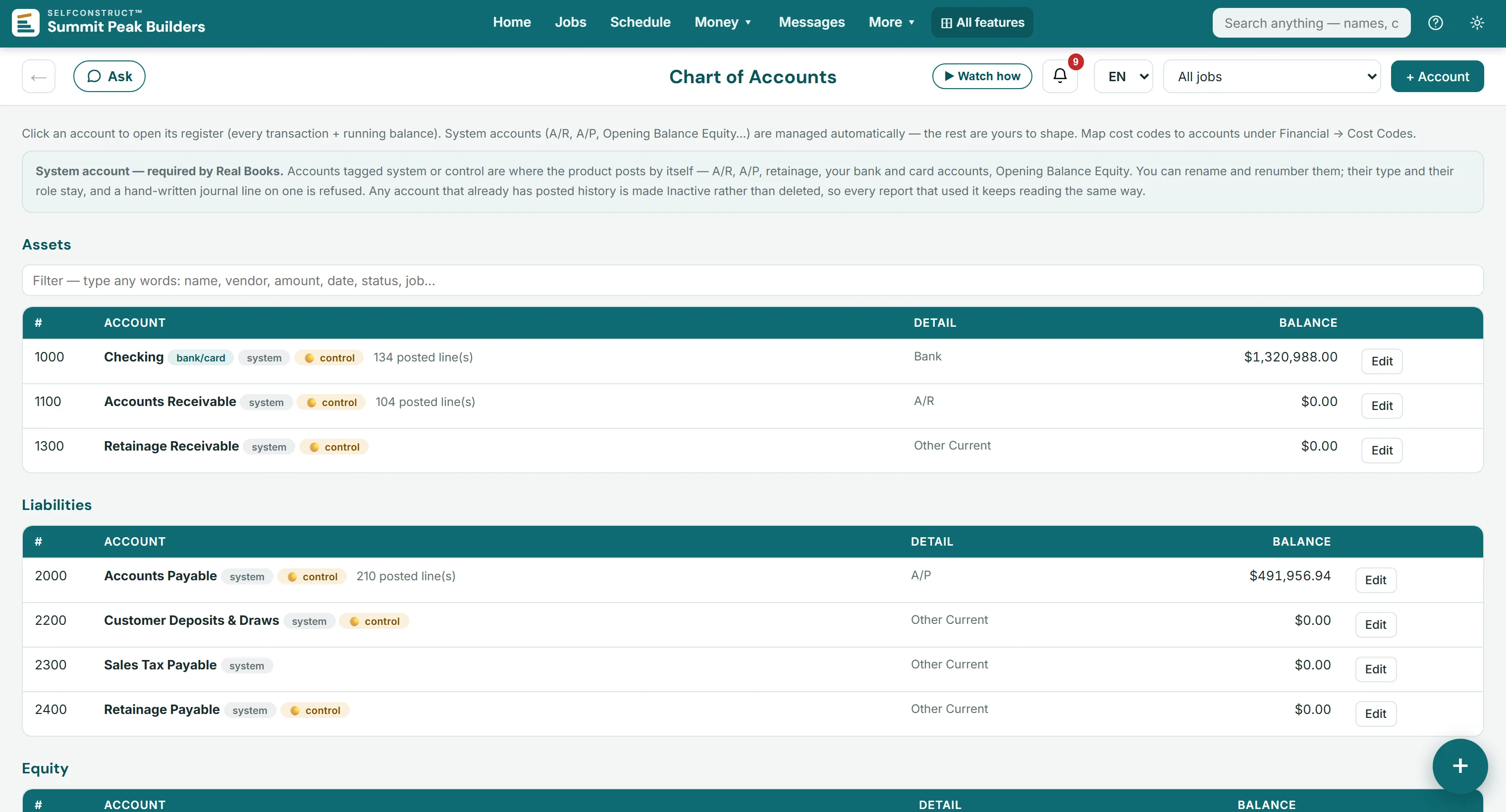
The two sides: held FROM you, held BY you
Retainage runs both directions. Retainage receivable is your money a client or GC is holding from your invoices — an asset you must chase at completion. Retainage payable is money you hold back from your subs' payments — a liability you owe when their scope finishes. A builder in the middle of a chain often carries both at once, and they don't cancel out: you can be waiting on $40,000 while owing $15,000.
Bill it visibly, or lose it invisibly
The classic failure: an invoice for $100,000 gets paid at $95,000, the $5,000 difference sits in 'accounts receivable' looking like a late payment, and eighteen months later nobody remembers it's retainage with a release condition. Every retainage dollar should carry its own label from the day it's withheld — on the invoice ('less 5% retainage'), and in the books as its own account, separate from ordinary receivables.
Releasing it: make the trigger a fact, not a feeling
Tie release to verifiable events named in the contract — substantial completion, punch-list signoff, certificate of occupancy — and invoice for it the day the trigger occurs. Retainage that isn't invoiced doesn't get released; it gets forgotten. The same discipline applies downstream: when your sub's scope closes out clean, releasing their retainage promptly is the cheapest goodwill you'll ever buy.
Keep it visible in your books
This is bookkeeping, not paperwork: retainage receivable and retainage payable should each be their own ledger account, so your balance sheet shows exactly how much of 'your' money is parked where. SelfConstruct's chart of accounts ships with both accounts built in, and because the ledger lives in the same system as the jobs, the withheld amounts stay attached to the jobs they came from.
Questions builders ask
What's a typical retainage percentage?
5% and 10% are the common figures in the United States, with some states capping rates or requiring escrow on public work — and many private contracts stepping down (for example, 10% until half complete, then 5%). Your state's rules and your contract control.
Is retainage income when earned or when released?
Ask your CPA — the answer depends on your accounting method. What every method needs is the same thing: retainage tracked in its own account so the amount is never in doubt.
Can I refuse retainage as a sub?
It's negotiable like any term. Subs commonly negotiate lower percentages, step-downs at milestones, or early release for early-finishing trades — but strike-throughs need to happen before signing, not after the first short check.
See it working right now
The live demo is a fictional construction company you can click through end to end — including a working client portal — the whole product, running. Pricing is published on the site: $299/mo per company, unlimited users, 50 GB of storage included.
Related
Explore SelfConstruct
© 2026 SelfConstruct™ · selfconstruct.app · Contact · Security · Privacy · Terms
hello@selfconstruct.app · (720) 919-3396 · SelfConstruct, LLC · PO Box 4158, Granby, CO 80446