How to build a construction draw schedule that gets you paid on time
A draw schedule is the payment plan for a construction contract: the job broken into stages, with an agreed amount released as each stage completes. Get it right and cash flows all the way through the build. Get it wrong and you're financing your client's house with your own money.
See pricing — it's public · Why SelfConstruct
Tie draws to milestones, never to dates
The single most important rule: a draw is earned by finishing something verifiable, not by surviving another month. 'Framing complete — roof dried in' is a milestone a lender's inspector can walk out and confirm. 'March 15' is just a date, and dates slip. Every dispute-resistant draw schedule reads like a punch list of provable states: excavation complete, foundation poured and backfilled, dried in, rough-ins passed inspection, drywall hung, trim and cabinets set, final walkthrough signed.
A typical 7-draw schedule for a custom home
Percentages vary by region and contract, but a common shape for a fixed-price custom build looks like: deposit at signing (5–10%), foundation complete (10–15%), framing and dry-in (20–25%), mechanical rough-ins passed (15–20%), insulation and drywall (10–15%), trim, cabinets and paint (15–20%), and final completion (10%, often held until the punch list clears). The front-loaded deposit covers mobilization and early materials; the final draw stays meaningful so everyone finishes strong.
Match the schedule to your actual cost curve
Your draws should track slightly ahead of your spend, never behind it. Lumber packages, truss orders, and window deposits land early — if your framing draw arrives after the framing invoices do, you're the bank. Before you sign, lay your estimated costs by phase next to the proposed draws and check that the running total of draws stays above the running total of costs the whole way through.
Retainage, deposits, and the last check
Many contracts hold back retainage — commonly 5–10% of each draw — released at final completion. Price it into your margin and track it as its own receivable, because a year of 10% holdbacks is real money. And put the final-draw conditions in writing up front: what 'complete' means, who signs off, and how many days after signoff payment is due.
Invoice each draw like you mean it
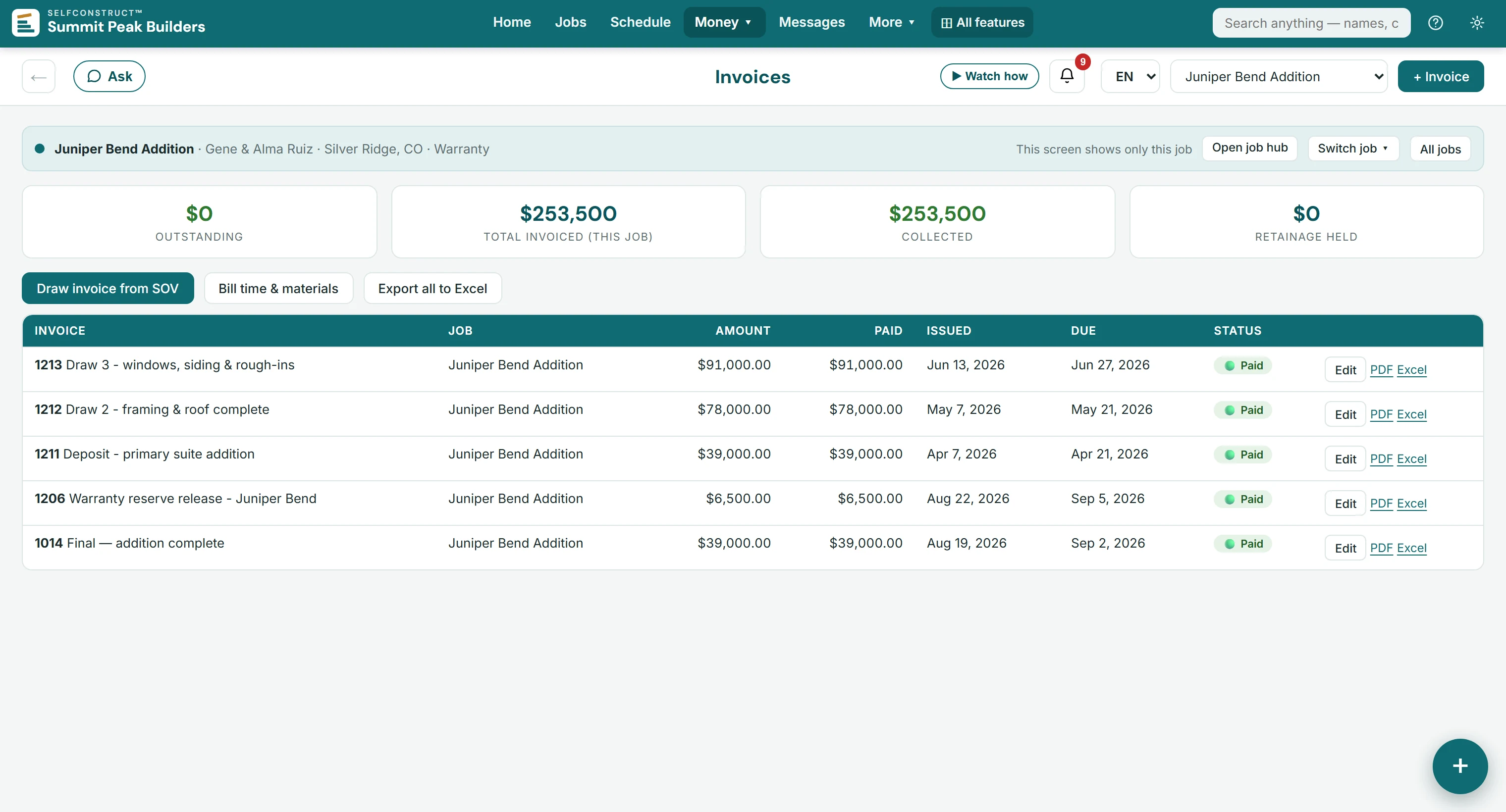
A draw request that gets paid fast names the milestone, shows it complete, states the contract amount, draws to date, this draw, and the remaining balance — and lands the day the milestone finishes, not at month-end. In SelfConstruct, draw invoices come off the contract with that math built in, the client sees the same numbers in their portal, and payment lands against the right job automatically.
Questions builders ask
How many draws should a custom home have?
Most fixed-price custom homes run five to eight draws. Fewer than five concentrates too much risk in each payment; more than ten turns into administrative drag for you, the client, and the lender.
What's the difference between a draw schedule and progress billing?
A draw schedule fixes the payment stages in the contract up front — common on residential work. Progress billing invoices a percentage of completion each period, common on commercial jobs, often on AIA-style forms with retainage held each cycle.
Who approves each draw?
On lender-financed jobs, the bank usually sends an inspector before releasing funds. On cash builds, the contract should name the trigger — typically the builder's notice of milestone completion, with the client's walkthrough for the later stages.
See it working right now
The live demo is a fictional construction company you can click through end to end — including a working client portal — the whole product, running. Pricing is published on the site: $299/mo per company, unlimited users, 50 GB of storage included.
Related
Explore SelfConstruct
© 2026 SelfConstruct™ · selfconstruct.app · Contact · Security · Privacy · Terms
hello@selfconstruct.app · (720) 919-3396 · SelfConstruct, LLC · PO Box 4158, Granby, CO 80446